Development boards
GetDMA development board catalogue: ESP32 and other microcontroller boards — the parts mouse-control modules and home-made devices are built from. Honest specifications, our own photos, shipped from St Petersburg.
Reviews in this catalogue
No one has reviewed these products yet — be the first
Share your experience
Bought from us? Tell others how it went.
Other catalogues
Nearby sections of the shop
 DMA cards — buy DMA cards at GetDMAGetDMA DMA card catalog: reliable, proven solutions for running DMA products. In stock, with a warranty and same-day shipping across Russia and the CIS. A choice of different DMA cards.4 products
 Fuser — buy a fuser at GetDMAGetDMA fuser (Fuser) catalog — we offer proven models, including current Dichen Fuser versions compatible with a wide range of monitors. Every fuser is tested and fully ready to work out of the box.5 products
 Makcu — catalog of mouse and keyboard control modules.GetDMA Makcu catalog: modules for mouse and keyboard control via the Makcu board. Reliable, compatible solutions for stable operation. In stock, with fast shipping across Russia and the CIS.3 products
 Mini PC — catalog of compact PCs for various tasksGetDMA Mini PC catalog: compact, powerful computers for work, gaming and running DMA. Reliable systems in a mini form factor, ready to use. Fast shipping and a warranty.2 products
What a development board is
A microcontroller with everything already around it: power, USB, reset and boot buttons, and pins in two rows along the edges. A bare chip would have to be soldered onto a board of your own with its power designed from scratch; here that work is done, and anything from a mouse to a display connects to the pins. You buy a dev board when the device is something you are building, not something you are buying finished.
What to look at
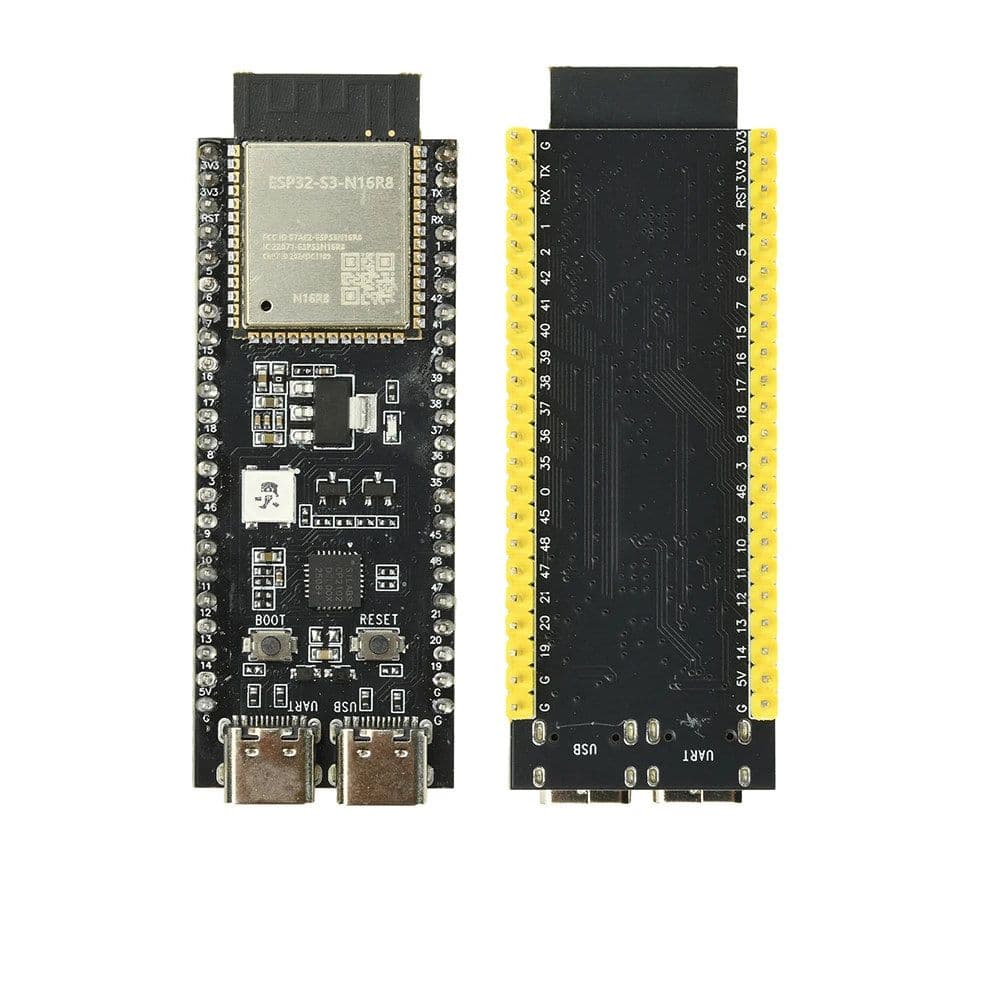
Memory. Flash holds the program, PSRAM holds data. On the ESP32-S3 it is spelled out in the name: N16R8 means 16 MB of flash and 8 MB of PSRAM, while cheaper builds ship 8 MB of flash and no PSRAM at all. The difference shows up in buffers, graphics and audio.
Ports. Two USB Type-C sockets are not always the same thing: one can be the controller’s native USB (the board can pretend to be a mouse or a keyboard), the other a UART for flashing and logs. With a single socket you have to choose between those two roles.
Form factor. A standard board — a DevKitC-1, say — takes other people’s enclosures, shields and wiring diagrams, and its pinout matches the documentation. A non-standard board is cheaper and leaves you to invent all of that again.
Which module is on it. The shielded can may be Espressif’s own (WROOM) or a compatible one — same chip, different maker and different certificates. We state which is which in the specifications rather than saying "original" and leaving it there.
Why a DMA shop stocks dev boards
The Makcu is built on the ESP32-S3: two controllers, one taking the mouse in, the other emulating it to the gaming PC. A board from this catalogue is that same chip on its own — for a build of your own, for a replacement, for firmware experiments. The boards arrive blank; no firmware is pre-installed.
Flashing and wiring
An ESP32 is flashed with ESP-IDF, the Arduino IDE, PlatformIO or a browser flasher — the tooling is open and the choice is yours. BOOT enters download mode. Pin headers usually come in the box but unsoldered, so the board fits a breadboard or an enclosure of your own.
Shipping and checks
Every board is tested before dispatch and the packed order is photographed — the picture arrives with the tracking number. A board ships together with Makcu modules, DMA cards and anything else in the same order: one parcel, one delivery. Questions about choosing — ask support.