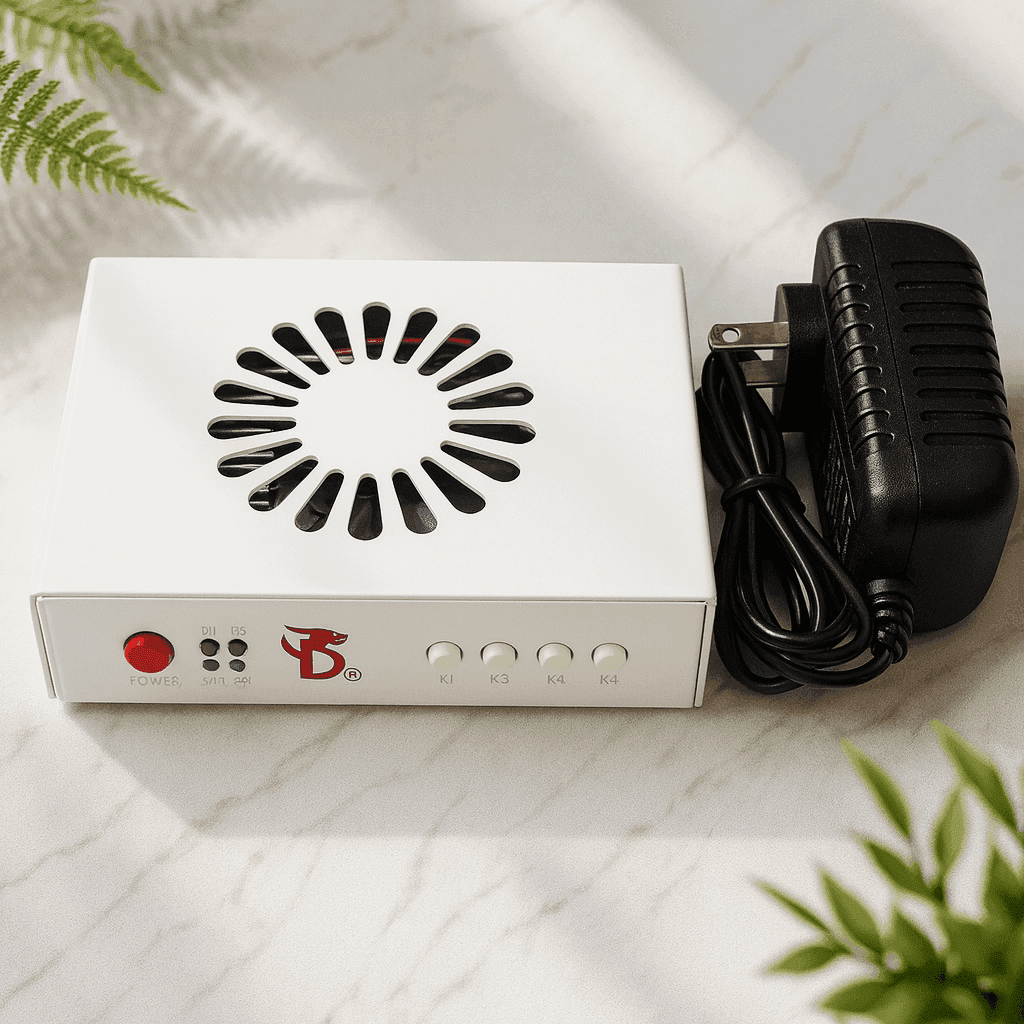
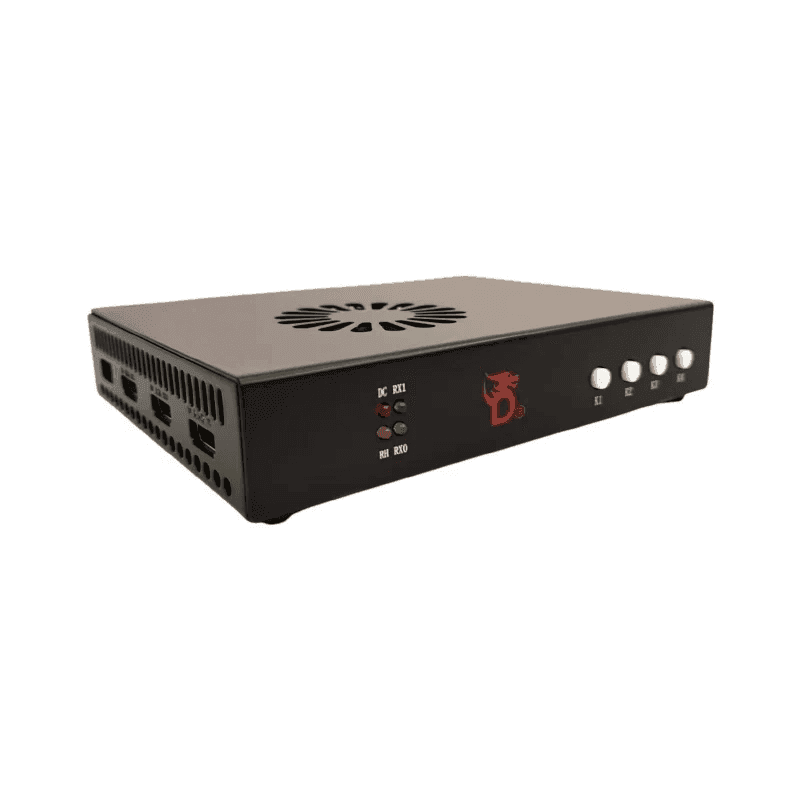
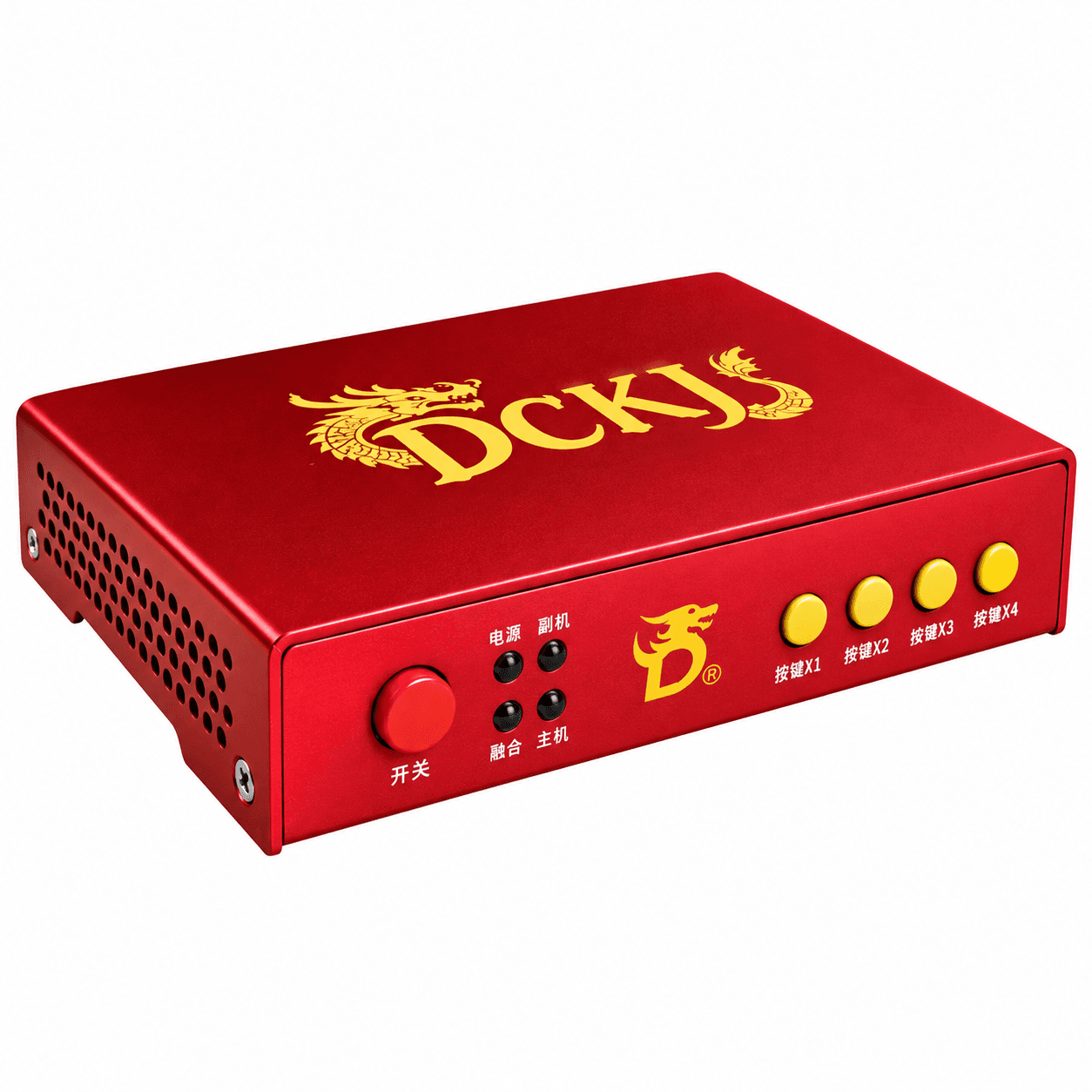
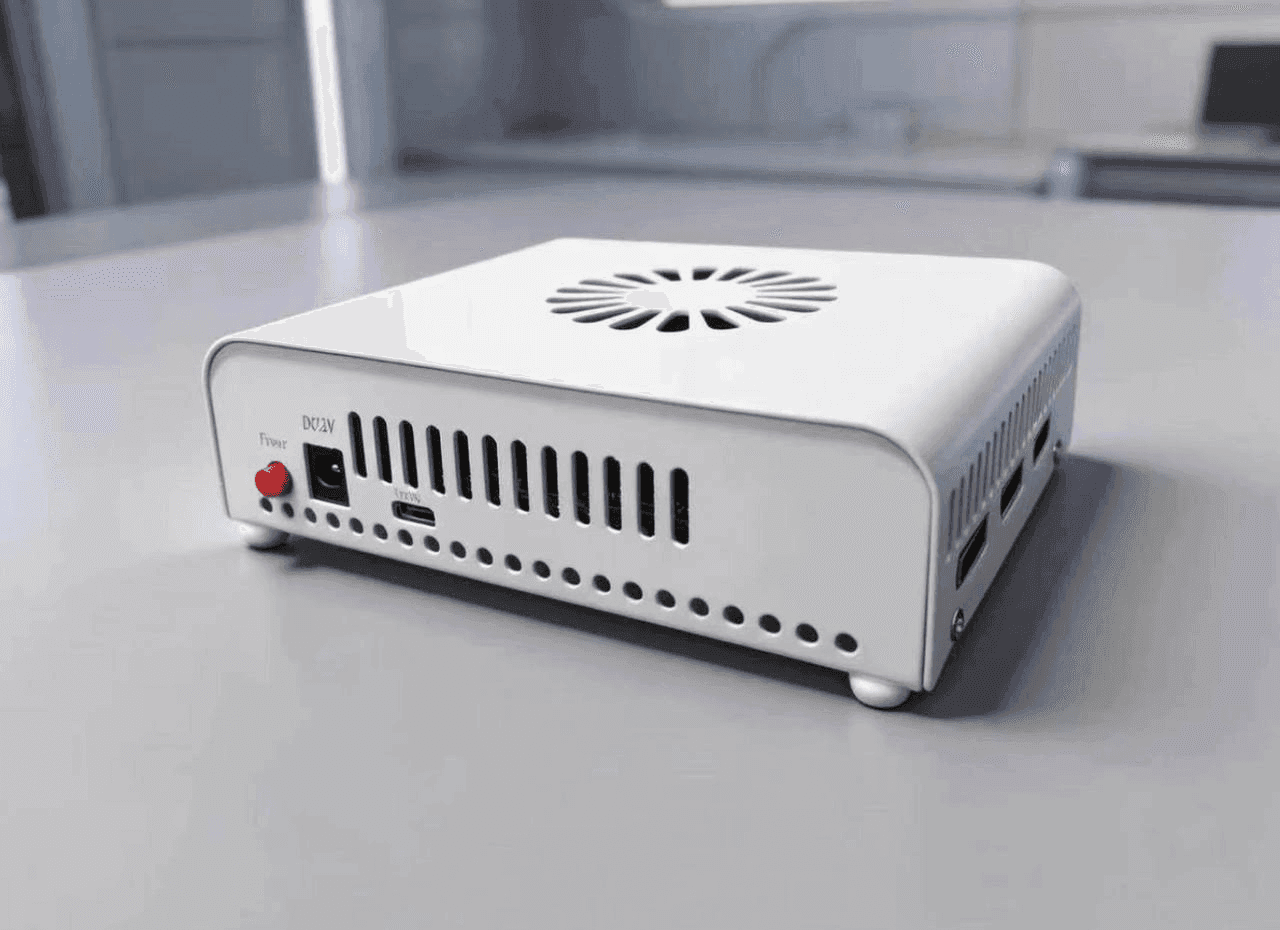
The DC1A686-D3ZC is the top model in DICHEN’s fuser line and the first built entirely around DisplayPort 1.4. Three ports run at full bandwidth, which puts its refresh rates beyond any HDMI fuser: 1080p reaches 639 Hz, 2K 364 Hz, ultrawide 3440×1440 264 Hz and 4K 164 Hz. At 1280×720 the manufacturer claims over 1000 Hz.
What a fuser does
It brings the picture of two computers onto one monitor and passes it through in hardware, over the cable, with no software layer. The second computer stays a separate machine with a screen of its own: switching between them is one button on the case — no cable swapping and none of a KVM’s lag.
Resolutions and refresh rates
- 1280×720 — over 1000 Hz;
- 1920×1080 — up to 639 Hz;
- 2560×1440 — up to 364 Hz;
- 3440×1440 (21:9) — up to 264 Hz;
- 3840×2160 — up to 164 Hz.
Colour is RGB and YCbCr at 8, 10 or 12 bits. The low-level DisplayPort protocols are supported: DDC, HPD, EDID, HDCP, MST, FEC and the AUX set.
What sets it apart from the smaller models
- Native EDID passthrough. The monitor reports its real capabilities, so the handshake is quick and free of communication errors.
- Editable display identifiers. The monitor’s serial number and hardware ID are changed with one press and kept in the device.
- Two displays at different resolutions. Primary and secondary run at once — 2K 360 Hz alongside 1K 360 Hz, for instance.
- Resolution scaling. A high-refresh 2K monitor accepts 1K at an ultra-high rate.
- Capture-card streaming. The signal can be fed to a capture card for recording and live streaming.
- Upgradable firmware. There is a service serial port on the board, and the manufacturer promises 5120×1440 in a future release.
DC1A686-D3ZC, DC1A255-H3 and DC505 side by side
The table is DICHEN’s own comparison. The last column is what they call “other brands’ DP 1.4 fusers”; where their sheet says “unknown”, so does this one.
| DC1A686-D3ZC | DC1A255-H3 | DC505 | Other brands |
|---|
| Interfaces | 3 × DP 1.4 | 3 × HDMI 2.0 | 3 × DP 1.4 + 3 × HDMI 2.1 | 3 × DP 1.4 |
| Peak refresh rate | 1000 Hz | 240 Hz | 540 Hz | 360 Hz |
| Modes | 720p 1000 Hz, 1K 639 Hz, 2K 364 Hz, 4K 164 Hz | 1K 240 Hz, 2K 120 Hz | 1K 540 Hz, 2K 355 Hz, 4K 155 Hz | 1K 360 Hz, 2K 240 Hz |
| Colour modes | Yes | Yes | No | No |
| Bit depth | 8 / 10 / 12-bit | 8-bit | 8 / 10-bit | Unknown |
| Full AUX communication | Yes | Yes | No | No |
| Protocols | DDC, HPD, EDID, HDCP, MST, FEC | HDCP, TMDS, CEC, HPD, SCL, SDA, EDID | HPD, EDID | HPD, EDID |
| Native EDID passthrough | Yes | Yes | Yes | Unknown |
| One-press EDID editing | Yes | No | No | No |
| EDID injection | No | No | Yes | Yes |
| Mixed resolutions at once | Yes | No | No | Unknown |
| Resolution scaling | Yes | No | No | Unknown |
| One-press host switching | Yes | Yes | Yes | Yes |
| Capture-card streaming | Yes | No | Yes | No |
Two rows do not read in the flagship’s favour, and they are better shown than hidden: it does not inject EDID — if you need to hand the system a different display profile, that is the DC505. And there is no HDMI on it at all: a monitor without a DisplayPort input cannot be connected to this model.
Compatibility
DICHEN tested the device against 62 monitor models from different brands and claims about 99 % compatibility within the supported bandwidth. What your monitor needs is simple: a DisplayPort 1.4 input and the refresh rate you intend to use.
Case colours
DICHEN Gold, Patriot Red and Loyal Silver are available from the manufacturer; Sincere White and Rock Black are out of stock for now. Confirm the colour when you order.